
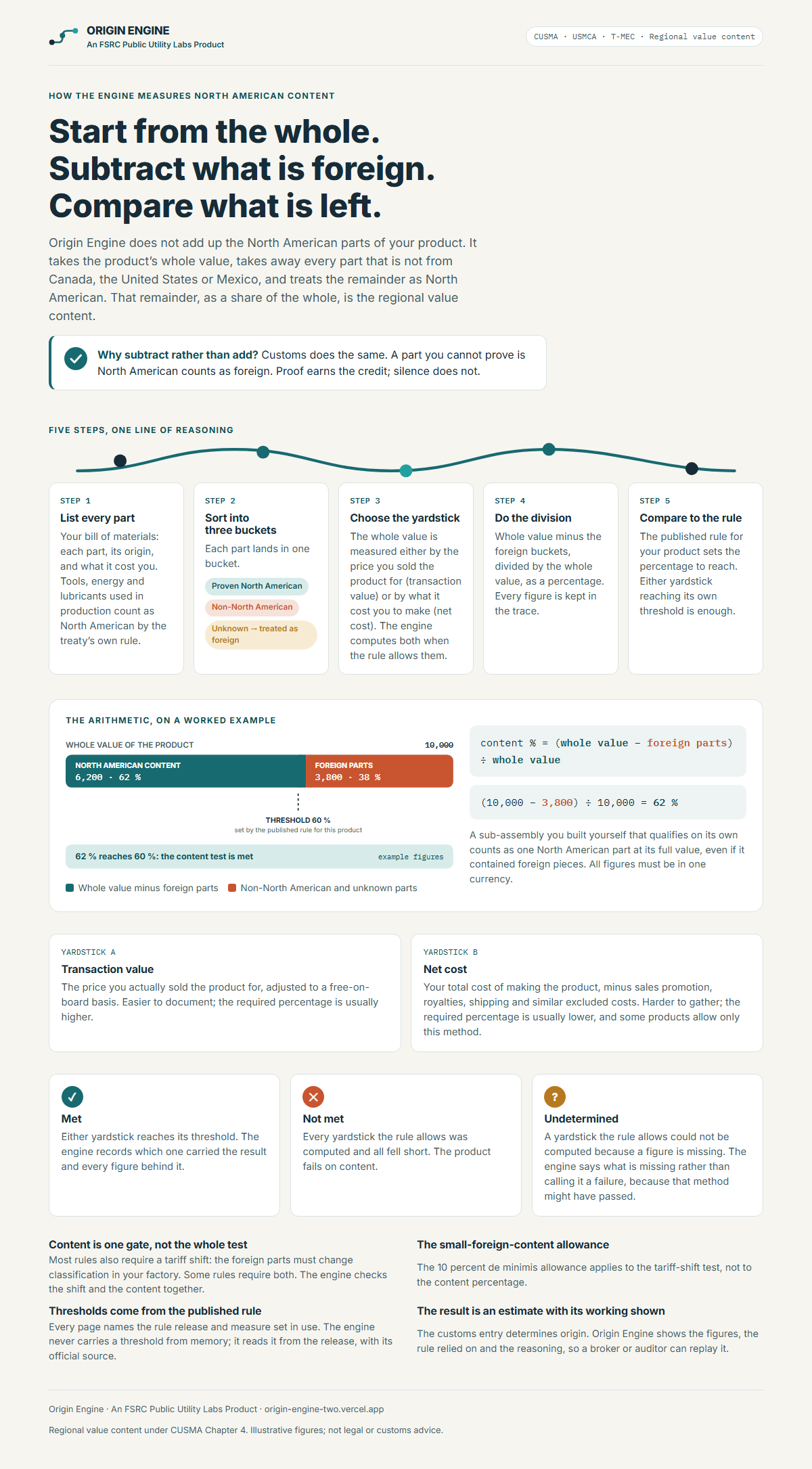
List every part
Your bill of materials: each part, its origin, and what it cost you. Tools, energy and lubricants used in production count as North American by the treaty’s own rule.
Rule release cusma-annex4b-2026-11-r5 is served: 3,090 rules, 1270 of them with a regional value content requirement; 62 provisions of Annex 4-B it does not carry yet, for which the engine gives no result.
How the engine measures North American content
Origin Engine does not add up the North American parts of your product. It takes the product’s whole value, takes away every part that is not from Canada, the United States or Mexico, and treats the remainder as North American. That remainder, as a share of the whole, is the regional value content.
Why subtract rather than add? Customs does the same. A part you cannot prove is North American counts as foreign. Proof earns the credit; silence does not.
Your bill of materials: each part, its origin, and what it cost you. Tools, energy and lubricants used in production count as North American by the treaty’s own rule.
Each part lands in one bucket.
The whole value is measured either by the price you sold the product for (transaction value) or by what it cost you to make (net cost). The engine computes both when the rule allows them.
Whole value minus the foreign buckets, divided by the whole value, as a percentage. Every figure is kept in the trace.
The published rule for your product sets the percentage to reach. Either yardstick reaching its own threshold is enough.
A sub-assembly you built yourself that qualifies on its own counts as one North American part at its full value, even if it contained foreign pieces. All figures must be in one currency.
The price you actually sold the product for, adjusted to a free-on-board basis. Easier to document; the required percentage is usually higher.
Your total cost of making the product, minus sales promotion, royalties, shipping and similar excluded costs. Harder to gather; the required percentage is usually lower, and some products allow only this method.
Either yardstick reaches its threshold. The engine records which one carried the result and every figure behind it.
Every yardstick the rule allows was computed and all fell short. The product fails on content.
A yardstick the rule allows could not be computed because a figure is missing. The engine says what is missing rather than calling it a failure, because that method might have passed.
Most rules also require a tariff shift: the foreign parts must change classification in your factory. Some rules require both. The engine checks the shift and the content together.
The 10 percent de minimis allowance applies to the tariff-shift test, not to the content percentage.
Every page names the rule release and measure set in use. The engine never carries a threshold from memory; it reads it from the release, with its official source.
The customs entry determines origin. Origin Engine shows the figures, the rule relied on and the reasoning, so a broker or auditor can replay it.